
Augmented Reality is reshaping how students learn, turning traditional classrooms into dynamic, interactive environments where digital content merges seamlessly with the physical world.

🚀 The Dawn of Immersive Learning Experiences
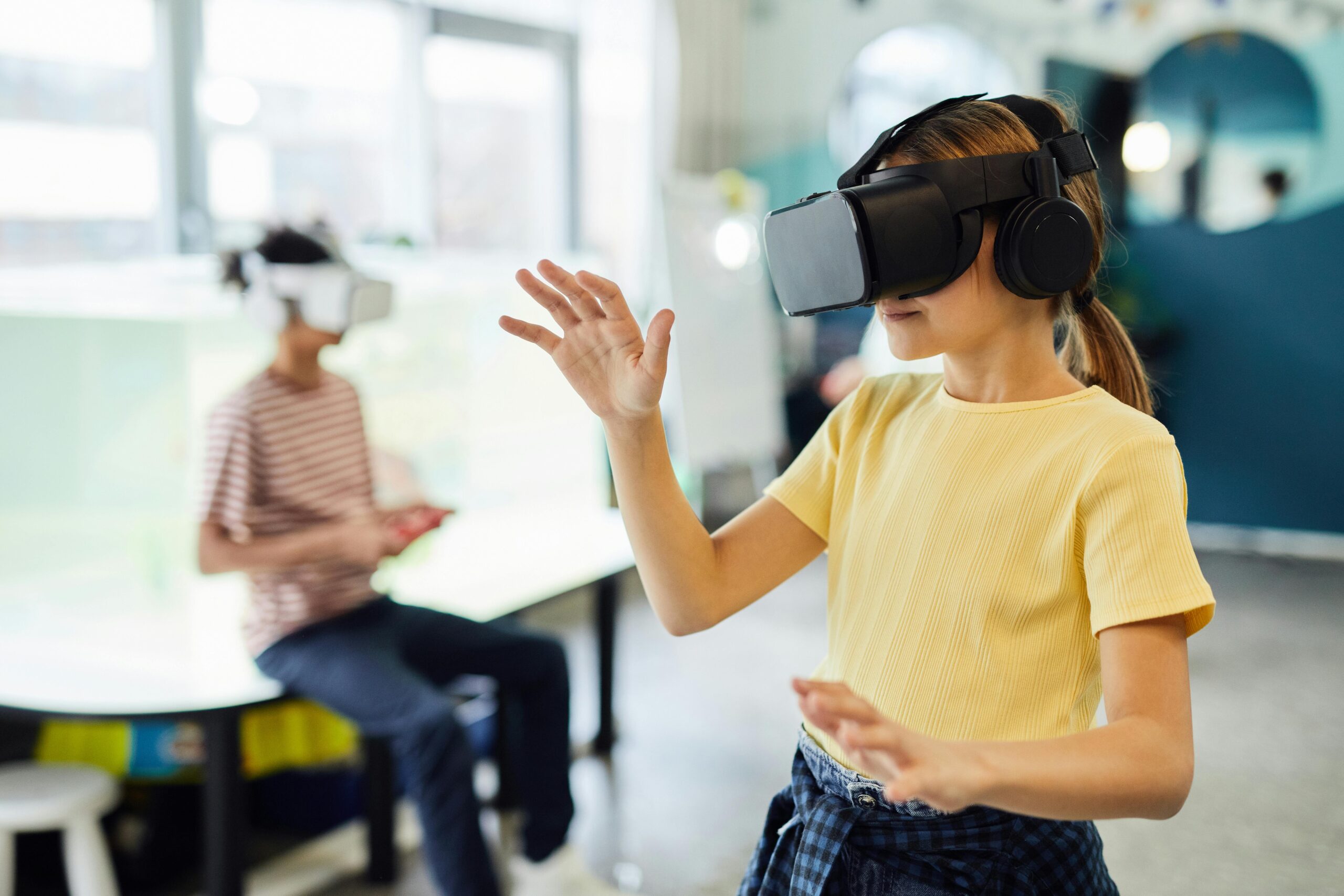
Education stands at a pivotal crossroads where technology meets pedagogy in unprecedented ways. Augmented Reality (AR) technology has emerged as a transformative force, offering educators and students alike the opportunity to transcend the limitations of conventional teaching methods. Unlike Virtual Reality, which creates entirely artificial environments, AR enhances real-world settings by overlaying digital information, 3D models, and interactive elements onto physical spaces.
The implementation of AR in educational settings addresses a fundamental challenge that teachers have faced for generations: maintaining student engagement while delivering complex concepts in accessible formats. Traditional textbooks and lecture-based approaches often struggle to capture the attention of digital-native students who have grown accustomed to interactive, multimedia experiences in their daily lives.
Research consistently demonstrates that immersive technologies like AR can significantly improve knowledge retention rates, with studies indicating retention improvements of up to 75% compared to traditional learning methods. This dramatic increase stems from AR’s ability to engage multiple sensory pathways simultaneously, creating memorable learning experiences that embed information more deeply into long-term memory.
📚 Bridging Abstract Concepts with Tangible Visualizations
One of AR’s most powerful applications in education lies in its capacity to make abstract concepts tangible. Complex scientific phenomena, mathematical principles, and historical events that once existed only in students’ imaginations can now be visualized, manipulated, and explored in three-dimensional space.
In chemistry classrooms, students can use AR applications to visualize molecular structures, rotating and examining compounds from every angle. They can observe chemical reactions in real-time without the safety concerns associated with physical laboratory experiments. Biology students can explore the human cardiovascular system by walking around a life-sized, beating heart hovering in their classroom, examining valves and blood flow patterns from perspectives impossible in traditional dissection.
Mathematics, often considered one of the most challenging subjects, becomes more intuitive through AR visualizations. Geometric concepts transform from abstract formulas into manipulable objects. Students can physically walk around three-dimensional graphs, understanding spatial relationships and mathematical functions in ways that blackboard drawings could never achieve.
Historical Immersion and Cultural Understanding
History education particularly benefits from AR’s ability to transport students across time and space. Ancient civilizations spring to life as students view reconstructions of historical sites overlaid onto their classroom environment. The Colosseum appears in its original glory, Egyptian pyramids reveal their construction secrets, and historical figures deliver speeches as holographic projections.
This temporal bridge doesn’t just make history more engaging—it fosters deeper empathy and cultural understanding. Students don’t merely read about historical events; they experience contextual elements that help them comprehend the human dimensions of history, developing critical thinking skills about cause, effect, and historical interpretation.
🎯 Personalized Learning Pathways Through Adaptive AR
The true revolution in AR-enhanced education extends beyond spectacular visualizations to personalized learning experiences. Advanced AR platforms incorporate artificial intelligence algorithms that adapt content difficulty, pacing, and presentation style based on individual student performance and learning preferences.
Traditional classrooms struggle with the reality that students learn at different rates and through different modalities. Visual learners, auditory processors, and kinesthetic students all sit in the same classroom, yet receive identical instruction. AR technology addresses this diversity by offering multiple representation modes simultaneously.
A student struggling with a concept can receive additional scaffolding through AR overlays that break down complex processes into smaller steps, while advanced learners access enrichment content that challenges them beyond standard curriculum. This differentiation occurs organically within the same physical space, eliminating the stigma sometimes associated with ability grouping.
Real-Time Assessment and Feedback Loops
AR systems provide educators with unprecedented insight into student comprehension through embedded assessment mechanisms. As students interact with AR content, the system continuously monitors their choices, response times, and problem-solving approaches, generating detailed analytics that inform instructional decisions.
This immediate feedback benefits students and teachers alike. Students receive instant correction and guidance, preventing the reinforcement of misconceptions. Teachers gain actionable data about class-wide understanding patterns, identifying topics that require additional instruction before moving forward.
🌐 Collaborative Learning in Shared AR Spaces
Modern education increasingly emphasizes collaboration, communication, and teamwork—skills essential for success in contemporary workplaces. AR technology facilitates collaborative learning experiences that would be impossible in traditional settings.
Multiple students can simultaneously interact with the same AR object, working together to solve problems, build structures, or conduct experiments. A group might collaboratively assemble a virtual engine, with each student responsible for different components. As they work, they must communicate effectively, coordinate their actions, and collectively troubleshoot challenges.
These shared AR experiences transcend physical boundaries. Students in different locations can collaborate within the same augmented environment, connecting classrooms across cities, countries, or continents. A biology class in Brazil might collaborate with students in Japan to study ecosystem differences, examining AR representations of each region’s flora and fauna side-by-side.
💡 Practical Applications Across Disciplines
The versatility of AR technology means virtually every academic discipline can leverage its capabilities to enhance instruction and engagement.
Language Learning Through Contextual Immersion
Language acquisition accelerates when vocabulary and grammar connect to meaningful contexts. AR applications can label physical objects in target languages, create interactive conversation scenarios with virtual native speakers, and provide pronunciation feedback through speech recognition integration.
Students learning Spanish might point their device at classroom objects, seeing the Spanish word overlaid with pronunciation guides. They could engage in simulated conversations at virtual restaurants, markets, or tourist locations, practicing language skills in contextually appropriate scenarios.
Engineering and Design Thinking
Engineering students benefit enormously from AR’s ability to visualize designs before physical prototyping. Architecture students can place full-scale building models in actual locations, assessing how structures interact with existing environments. Mechanical engineering students can examine internal mechanisms of machines, understanding how components interact without dismantling physical equipment.
The design thinking process becomes more iterative and experimental when students can rapidly prototype ideas in AR, testing concepts, gathering feedback, and refining designs without material costs or time constraints associated with physical prototyping.
Arts and Creative Expression
Artistic education expands into new dimensions through AR tools that blend physical and digital creativity. Students can create mixed-reality art installations, design virtual sculptures that interact with physical spaces, or animate their traditional drawings into moving digital artworks.
Music education benefits from AR visualizations of sound waves, musical theory concepts, and interactive instrument tutorials that overlay fingering guides onto physical instruments, accelerating skill acquisition for beginning musicians.
🔧 Overcoming Implementation Challenges
Despite AR’s transformative potential, educators face legitimate challenges when integrating this technology into established educational systems. Addressing these obstacles thoughtfully ensures successful implementation that genuinely enhances rather than disrupts learning.
Infrastructure and Access Considerations
AR experiences require hardware—typically smartphones, tablets, or specialized headsets—along with robust internet connectivity. Schools in economically disadvantaged areas may struggle to provide devices for all students, potentially exacerbating existing educational inequalities.
Solutions include device-sharing programs, partnerships with technology companies for educational discounts, and the development of AR experiences that work on lower-specification devices. Some innovative schools implement BYOD (Bring Your Own Device) policies, leveraging students’ personal smartphones while providing loaners for those without access.
Professional Development for Educators
Technology alone doesn’t transform education—skilled educators who understand how to integrate tools pedagogically create meaningful change. Many teachers feel unprepared to incorporate AR into their instruction, lacking both technical skills and conceptual frameworks for effective implementation.
Comprehensive professional development programs must accompany AR adoption, providing teachers with hands-on experience, pedagogical strategies, and ongoing support. Teacher training should emphasize not just how to use AR tools, but when and why to use them, ensuring technology serves educational objectives rather than becoming a distraction.
Content Quality and Curriculum Alignment
The educational AR market has expanded rapidly, with varying quality among available applications. Some AR experiences prioritize novelty over educational value, creating engaging but pedagogically shallow content that fails to advance learning objectives.
Educators need evaluation frameworks to assess AR content quality, ensuring resources align with curriculum standards, reflect accurate information, and support measurable learning outcomes. Collaboration between content developers, subject matter experts, and experienced teachers produces the highest-quality educational AR experiences.
📊 Measuring Impact and Learning Outcomes
As schools invest resources in AR technology, stakeholders rightfully demand evidence of educational impact. Measuring AR’s effectiveness requires moving beyond simple engagement metrics to assess genuine learning gains and skill development.
Preliminary research indicates promising results across multiple dimensions:
- Improved standardized test scores in subjects incorporating AR instruction
- Increased student motivation and voluntary engagement with learning materials
- Enhanced spatial reasoning and three-dimensional visualization skills
- Better retention of complex information weeks and months after initial instruction
- Improved collaborative problem-solving capabilities
- Reduced anxiety around traditionally challenging subjects like mathematics and science
Long-term studies are still needed to fully understand AR’s educational impact, particularly regarding higher-order thinking skills, creativity development, and transfer of knowledge to novel situations. Ongoing research will refine best practices and identify which AR applications produce the most significant learning benefits.
🌟 The Future Landscape of AR-Enhanced Education
Current AR educational applications represent merely the beginning of this technology’s potential. Emerging developments promise even more sophisticated and seamless integration of augmented content into learning experiences.
Advances in wearable AR technology, particularly improved smart glasses, will eliminate the barrier of handheld devices, allowing more natural interactions with augmented content. Students will simply look at objects or locations to access relevant information, maintaining eye contact during discussions while still accessing digital resources.
Artificial intelligence integration will create increasingly sophisticated adaptive learning systems that understand not just what students know, but how they think, adjusting instructional approaches in real-time to optimize comprehension for each individual learner.
Haptic feedback technology will add tactile dimensions to AR experiences, allowing students to “feel” virtual objects, further engaging sensory systems and deepening immersive learning. A medical student might feel tissue resistance while practicing virtual surgical procedures, or a physics student might sense forces acting on simulated objects.
🎓 Preparing Students for an Augmented Future
Beyond immediate educational benefits, AR classroom experiences prepare students for a professional world increasingly incorporating augmented reality across industries. From manufacturing floors using AR for assembly guidance to medical facilities employing AR surgical assistance, tomorrow’s workforce will regularly interact with augmented environments.
Students developing AR literacy in educational settings gain comfort with these technologies, understanding both their capabilities and limitations. This familiarity positions them advantageously as they enter careers where augmented reality represents standard operational tools rather than exotic novelties.
Critical thinking about technology also develops through regular AR interaction. Students learn to evaluate digital information sources, understand how augmented content is created and can be manipulated, and consider ethical implications of technologies that blur boundaries between physical and digital realities.
🌈 Creating Inclusive Learning Environments
AR technology offers remarkable potential for creating more inclusive educational experiences that accommodate diverse learning needs. Students with certain disabilities find AR particularly beneficial, as it can adapt content presentation in ways traditional materials cannot.
Visually impaired students benefit from AR applications that provide audio descriptions of visual content or enhance remaining vision through magnification and contrast adjustments. Students with hearing impairments access real-time captioning and visual representations of auditory information. Those with attention challenges find AR’s interactive nature helps maintain focus more effectively than passive learning modalities.
Language barriers diminish as AR applications provide real-time translation overlays, allowing multilingual classrooms to access identical content in their preferred languages simultaneously. This inclusivity extends educational opportunities to diverse student populations, ensuring technology serves equity rather than reinforcing existing disparities.
✨ Empowering Educators as Learning Experience Designers
The integration of AR into classrooms fundamentally transforms the teacher’s role from information deliverer to learning experience designer. Rather than primarily transmitting knowledge, educators curate, customize, and orchestrate immersive experiences that guide students toward discovery and understanding.
This evolution empowers teachers to focus on uniquely human aspects of education—mentorship, emotional support, ethical guidance, and facilitation of meaningful discussions. As AR handles content delivery and initial skill practice, educators can invest energy in higher-level interactions that machines cannot replicate.
Teacher creativity flourishes in AR-enhanced environments, as educators design custom augmented experiences tailored to their students’ specific interests, local contexts, and cultural backgrounds. A history teacher might create AR experiences featuring local historical sites, while a biology teacher develops augmented field guides featuring regional species.
The future of education lies not in replacing human teachers with technology, but in empowering educators with tools that amplify their effectiveness, allowing them to reach every student more meaningfully. Augmented Reality represents a powerful addition to the educational toolkit—one that, when implemented thoughtfully and equitably, can truly transform learning experiences and unlock human potential in ways previously unimaginable.
As we stand at this educational frontier, the question is no longer whether AR will transform education, but how quickly we can responsibly implement these technologies to benefit all learners. The classrooms of tomorrow are being built today, one augmented experience at a time, creating learning environments where imagination, technology, and pedagogy converge to prepare students not just for tests, but for lives of curiosity, creativity, and continuous growth.