
Augmented reality is transforming how future doctors, nurses, and surgeons prepare for life-saving procedures through immersive, risk-free training environments that bridge classroom theory and operating room reality.

🔬 The Evolution Beyond Traditional Medical Education
Medical training has relied on textbooks, cadaver dissection, and supervised clinical rotations for centuries. While these methods built foundational knowledge, they come with inherent limitations—cadavers don’t bleed or react to medications, mannequins lack physiological complexity, and real patients present ethical concerns for novice practitioners. The stakes in healthcare demand perfection, yet traditional training methods offer limited opportunities for repetitive practice without consequences.
Augmented reality-guided simulations represent a paradigm shift in medical education. By overlaying digital information onto the physical world, AR creates interactive learning experiences where trainees can practice complex procedures repeatedly, receive instant feedback, and develop muscle memory in environments that closely mirror actual clinical settings. This technology doesn’t replace traditional methods but amplifies them, creating a comprehensive training ecosystem that produces more confident, competent healthcare professionals.
Understanding AR-Guided Medical Simulations
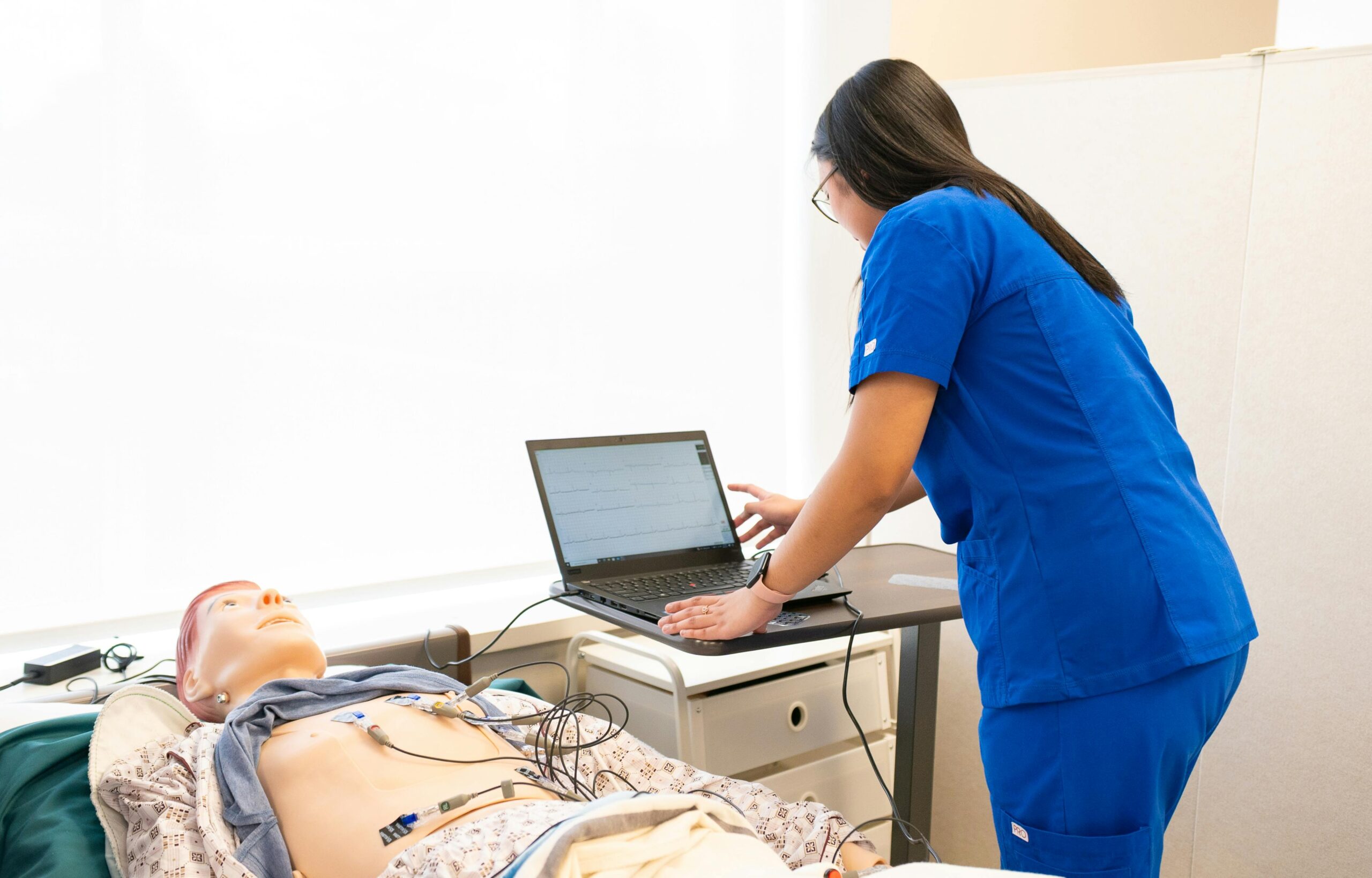
AR medical simulations combine physical mannequins or standardized patients with digital overlays that display anatomical structures, vital signs, and procedural guidance in real-time. Unlike virtual reality that creates completely artificial environments, augmented reality enhances the physical world with digital elements, allowing trainees to maintain spatial awareness while accessing information that would be invisible in traditional settings.
These systems typically involve head-mounted displays, tablets, or projection systems that superimpose three-dimensional anatomical models, procedural steps, and real-time data onto the training environment. Trainees can visualize blood vessels beneath skin surfaces, see organ positioning during palpation, or follow step-by-step surgical techniques aligned with their actual hand movements.
Core Components of Effective AR Training Systems
Successful AR medical training platforms integrate several critical elements. High-fidelity anatomical models based on actual medical imaging provide accurate representations of human physiology. Haptic feedback systems simulate tissue resistance, allowing trainees to feel the difference between healthy and diseased tissue. Real-time performance tracking captures metrics like hand steadiness, procedural accuracy, and decision-making speed.
Advanced systems incorporate artificial intelligence that adapts difficulty levels based on trainee performance, presents realistic complications at appropriate intervals, and provides personalized feedback identifying specific areas for improvement. This intelligent scaffolding ensures learners face appropriate challenges without becoming overwhelmed or under-stimulated.
🎯 Mastering Critical Procedures Through Immersive Practice
AR simulations excel at teaching high-stakes procedures that require precision and confidence. Surgical trainees can practice laparoscopic techniques with AR overlays showing optimal instrument angles, critical anatomical landmarks, and potential danger zones. The technology allows repetition of complex maneuvers hundreds of times before ever approaching a real patient, building both technical proficiency and psychological preparedness.
Emergency medicine procedures benefit tremendously from AR training. Intubation, central line placement, and chest tube insertion require split-second decision-making and precise hand movements. AR simulations can present these scenarios with varying patient anatomies, emergency complications, and time pressures, preparing practitioners for the unpredictable nature of acute care settings.
Building Diagnostic Excellence Through Visual Enhancement
Diagnostic skills form the foundation of effective medical practice. AR technology enhances physical examination training by overlaying anatomical structures during palpation, auscultation, and percussion. Students learning cardiac auscultation can see heart valves opening and closing in synchronization with the sounds they hear, creating multisensory learning that improves pattern recognition and diagnostic accuracy.
Radiological interpretation training also benefits from AR integration. Trainees can examine actual imaging studies while AR overlays highlight pathologies, trace vascular structures, or demonstrate how findings correlate with patient positioning. This bridges the gap between two-dimensional images and three-dimensional anatomical understanding.
Psychological Preparedness and Stress Inoculation
Technical skill represents only part of clinical competence. Healthcare professionals must perform under extreme pressure, managing life-threatening emergencies while maintaining clear thinking and steady hands. AR simulations create realistic stress environments where trainees experience physiological arousal similar to actual clinical scenarios without risking patient safety.
These stress inoculation experiences help practitioners recognize their own stress responses, develop coping mechanisms, and build confidence in their abilities. Repeated exposure to high-pressure simulated scenarios reduces anxiety when facing similar situations with real patients, improving performance during critical moments.
Team Coordination and Communication Training
Modern healthcare demands seamless teamwork. AR platforms enable multi-user simulations where entire teams practice coordinating complex procedures. During simulated trauma resuscitations, team members see shared AR displays showing patient vitals, medication administration schedules, and assigned roles, while instructors track communication patterns and decision-making processes.
These collaborative simulations reveal communication breakdowns, highlight leadership strengths and weaknesses, and create opportunities to practice standardized communication protocols like SBAR (Situation, Background, Assessment, Recommendation) in realistic contexts.
📊 Measurable Outcomes and Performance Analytics
One of AR training’s most powerful advantages is comprehensive data collection. Every hand movement, decision point, and timing metric can be captured and analyzed. This objective performance data eliminates the subjectivity inherent in traditional observational assessments, providing trainees with concrete evidence of improvement and identifying specific weaknesses requiring additional practice.
Training programs can establish competency benchmarks based on expert performance data. Trainees progress through skill levels only after consistently meeting objective criteria, ensuring standardized competency across all graduates. This data-driven approach to credentialing provides stronger evidence of readiness than traditional time-based training models.
Personalized Learning Pathways
AR systems with AI integration create individualized training curricula. By analyzing performance patterns, these platforms identify knowledge gaps and skill deficiencies, automatically adjusting content delivery and practice scenarios. A trainee struggling with anatomical landmark identification receives additional exercises focused on that specific weakness, while someone excelling in technical execution faces more complex clinical decision-making scenarios.
This personalization maximizes training efficiency, reducing time to competency while ensuring comprehensive skill development. Learners advance at their own pace, receiving support where needed without being held back by group-based instruction timelines.
Overcoming Geographic and Resource Barriers 🌍
Access to quality medical training varies dramatically across geographic regions and institution resources. Major academic medical centers offer extensive training opportunities with diverse patient populations and subspecialty exposure. Rural or resource-limited settings often lack this variety, creating disparities in training quality and healthcare outcomes.
AR training platforms democratize access to high-quality education. A medical student in a remote location can practice rare surgical procedures, encounter uncommon pathologies, and receive expert feedback through AR simulations that were previously accessible only at elite institutions. This geographic leveling improves healthcare quality globally by ensuring standardized training regardless of physical location.
Cost-Effectiveness and Scalability
While AR technology requires initial investment, the long-term cost-effectiveness surpasses traditional training methods. Physical simulation models deteriorate with use, cadavers are expensive and limited, and clinical training time competes with patient care efficiency. AR simulations can be repeated infinitely without additional material costs, scaled across multiple institutions simultaneously, and updated with latest evidence-based practices through software updates.
The return on investment extends beyond direct training costs. Better-prepared practitioners make fewer errors, require less supervision, and achieve competency faster, reducing the hidden costs of prolonged training periods and preventable medical errors.
Integration with Existing Medical Curricula
Successful AR implementation requires thoughtful integration with established educational frameworks rather than wholesale replacement of traditional methods. The most effective approaches use AR as a complementary tool that enhances rather than replaces foundational learning experiences.
Early medical education benefits from AR anatomy visualization that brings textbook illustrations to life. Pre-clinical students can explore three-dimensional anatomical relationships, manipulate virtual organs, and understand spatial relationships impossible to convey through two-dimensional media. This foundation prepares students for more advanced applications during clinical rotations.
Bridging Simulation and Clinical Practice
The transition from simulated environments to actual patient care represents a critical juncture in medical training. AR technology creates a graduated pathway by enabling supervised practice with actual patients where AR overlays provide real-time guidance and safety alerts. An intern performing their first unsupervised procedure might use AR assistance that highlights anatomical structures and warns if instruments approach critical areas, gradually fading this support as competence increases.
This scaffolded approach maintains patient safety while allowing appropriate autonomy development, reducing the anxiety associated with transitioning from simulation to real-world practice.
🚀 Future Directions and Emerging Capabilities
Current AR medical training represents just the beginning of this technology’s potential. Emerging developments promise even more sophisticated and effective training experiences. Photorealistic graphics rendering will create indistinguishable simulations from actual tissues and anatomical structures. Advanced haptic systems will replicate subtle textural differences between healthy and diseased tissues with remarkable accuracy.
Integration with telemedicine platforms will enable remote expert guidance during both training and actual procedures. A surgeon performing a rare operation could receive AR-overlaid guidance from a distant specialist who sees the exact same view and can annotate the surgical field in real-time, creating unprecedented opportunities for knowledge transfer and collaborative care.
Artificial Intelligence and Adaptive Learning
Next-generation AR platforms will incorporate sophisticated AI that not only tracks performance but predicts learning trajectories and identifies optimal teaching strategies for individual learners. Machine learning algorithms trained on thousands of expert performances will provide increasingly nuanced feedback, recognizing subtle technique variations that human instructors might miss.
These systems will also generate limitless novel scenarios by combining clinical elements in unique configurations, ensuring trainees never encounter identical situations twice and developing true adaptive expertise rather than scripted responses to memorized scenarios.
Addressing Implementation Challenges and Concerns
Despite tremendous potential, AR medical training faces several obstacles to widespread adoption. Initial costs create barriers for resource-limited institutions, though prices continue declining as technology matures. Technical complexity requires dedicated support staff and ongoing maintenance that some programs struggle to provide.
Faculty development presents another challenge. Instructors trained in traditional methods must develop competence with AR platforms and learn how to integrate these tools effectively into curricula. This transition requires institutional commitment to professional development and willingness to modify established teaching approaches.
Maintaining the Human Element
Technology enthusiasts sometimes oversell digital solutions as complete replacements for human interaction. Effective medical practice requires empathy, communication skills, and ethical reasoning that cannot be fully developed through technology alone. The most successful training programs balance AR technical skill development with mentorship, patient interaction, and humanistic education that develops the complete clinician.
AR simulations should enhance rather than replace the patient-centered focus of medical education. Technology serves as a tool for skill development, creating more competent practitioners who can then focus attention on the human dimensions of care rather than struggling with technical execution.
Transforming Healthcare Through Better-Prepared Practitioners 💡
The ultimate measure of any educational innovation is its impact on patient outcomes. AR-trained healthcare professionals enter practice with greater technical proficiency, higher confidence levels, and more extensive experience with rare conditions and complications than traditionally trained peers. This enhanced preparation translates directly into improved patient safety, better clinical outcomes, and more efficient healthcare delivery.
As AR training becomes standard rather than exceptional, we can anticipate reductions in preventable medical errors, decreased complication rates, and improved patient satisfaction. Healthcare institutions benefit from practitioners who require less supervision, achieve independent practice sooner, and maintain higher performance standards throughout their careers.
The Inevitable Transformation of Medical Education
Augmented reality-guided simulations represent not a temporary trend but a fundamental evolution in how we prepare healthcare professionals. The technology addresses longstanding limitations in medical training while creating entirely new capabilities previously impossible. As systems become more sophisticated, accessible, and integrated into standard curricula, AR training will transition from innovative supplement to essential component of medical education.
The healthcare professionals of tomorrow will look back on current training methods with the same perspective we now have on outdated practices from decades past—necessary steps in education’s evolution but incomplete compared to the comprehensive, technology-enhanced preparation that will become the new standard. This transformation promises not only better-trained practitioners but ultimately improved health outcomes for the patients they will serve throughout their careers.
Institutions, educators, and healthcare systems that embrace this transition position themselves at the forefront of medical education excellence, while those that resist risk producing graduates inadequately prepared for modern healthcare’s demands. The question is no longer whether AR will transform medical training, but how quickly and completely that transformation will occur.